
What is a DDoS Attack Vector?
A DDoS attack vector is a distinct traffic pattern used to overwhelm a Target. Each vector exploits different layers of the network or application stack to test the effectiveness of your defenses.
In the RADAR platform, each attack vector represents a predefined scenario that mimics real-world threats, with unique traffic patterns, payloads, and timing to assess mitigation effectiveness across diverse threat models.
What You'll Learn on This Page
On this page, you’ll learn about the DDoS attack vectors supported by the RADAR platform and how they are structured into three distinct coverage groups. Each group is designed to help assess and validate mitigation capabilities across varying levels of complexity and threat sophistication.
This page also provides insight into the attack categories represented by these vectors. Attack categories in RADAR are logical groupings of DDoS attack vectors that reflect the different protocol layers and techniques used to generate malicious traffic. These categories allow simulations to be tailored to specific threat patterns.
Together, these coverage groups and attack categories deliver progressively deeper levels of validation, ensuring defenses align with the resilience requirements of an environment.
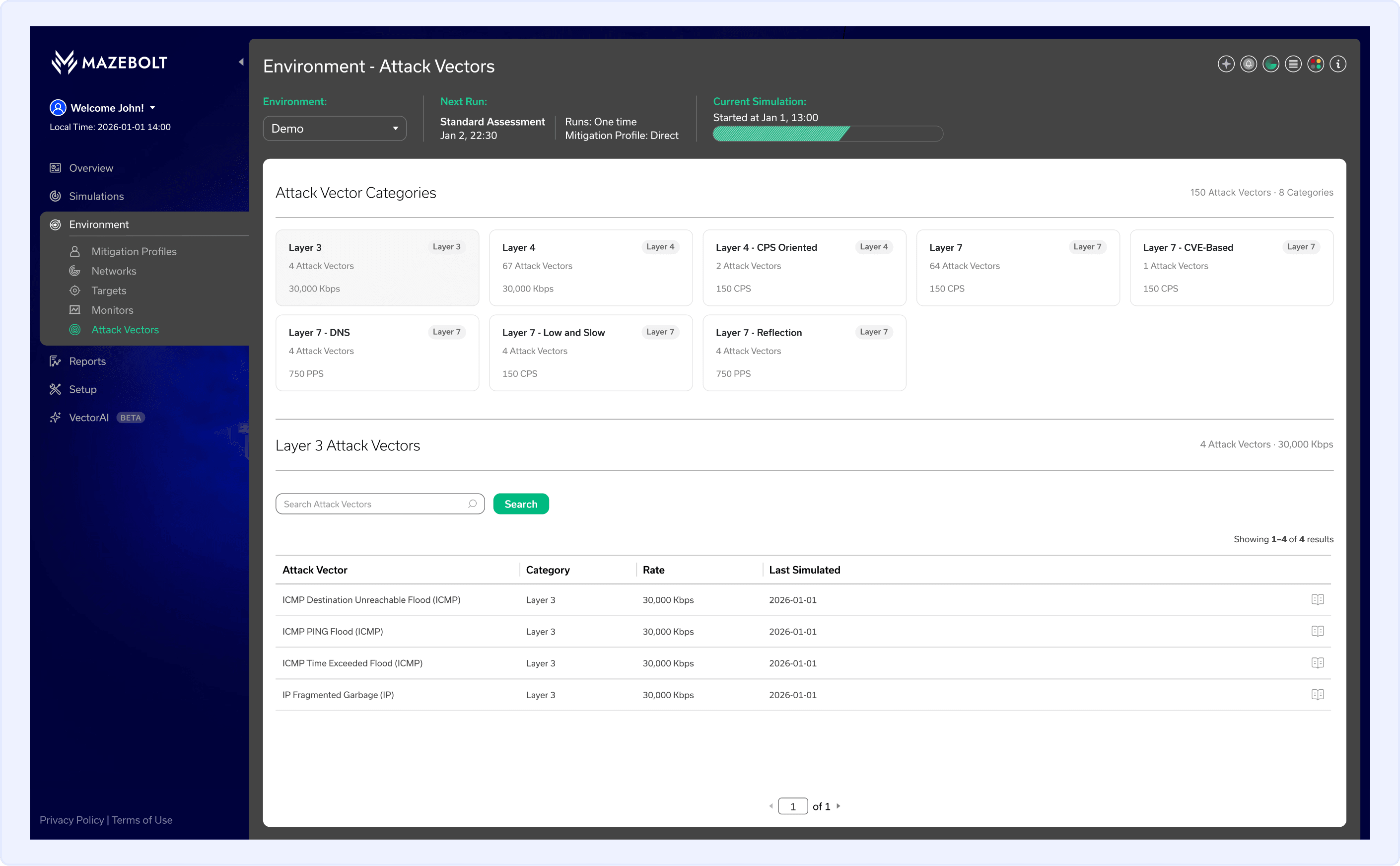
To view which of these attack vectors are actively simulated in a specific environment, along with the simulation rate and the date each vector was last run:
- In the left-hand menu, select Environments.
- Select Attack Vectors.
Coverage Groups
- BaseLine Group: This group includes 24 of the most common and diversed DDoS attack vectors. It is designed to validate the core mitigation mechanisms that protect against over 95% of DDoS attacks observed across the industry, regardless of the mitigation vendor.
- BaseLine Plus Group: This group adds 33 additional DDoS attack vectors, bringing the total to 57. This expanded set delivers broader validation coverage.
- Complete Insight Group: This group adds 93 additional DDoS attack vectors, for a comprehensive suite of 150. It is designed to include even the most uncommon and sophisticated vectors, to ensure every defensive mechanism operates as expected.
Attack Vectors by Coverage Groups
Note
Layer - represents different levels or categories of DDoS attacks, providing a way to classify and better understand the type and impact of each attack.
1. BaseLine
| # | Attack Name | Layer | IPv4 | IPv6 | CDN and Proxy Support |
|---|---|---|---|---|---|
| 1 | ACK-PSH Flood (TCP) | 4 | ✔ | ||
| 2 | All TCP Flags Flood (TCP) | 4 | ✔ | ||
| 3 | HTTP Browser Simulation (TCP) | 7 | ✔ | ✔ | ✔ |
| 4 | HTTP CONNECT Flooder (TCP) | 7 | ✔ | ✔ | ✔ |
| 5 | HTTP HTTP GoldenEye (TCP) | 7 | ✔ | ✔ | ✔ |
| 6 | HTTP MHDDOS CFB (TCP) | 7 | ✔ | ✔ | ✔ |
| 7 | Empty Connection Flood (R) (TCP) | 7 | ✔ | ✔ | |
| 8 | FIN Flood (TCP) | 4 | ✔ | ||
| 9 | HTTP MHDDOS HEAD (TCP) | 7 | ✔ | ✔ | ✔ |
| 10 | HTTP TRACE Flooder (TCP) | 7 | ✔ | ✔ | ✔ |
| 11 | HTTPS Flood - Browser Simulation (TCP) | 7 | ✔ | ✔ | ✔ |
| 12 | HTTPS Flooder (TCP) | 7 | ✔ | ✔ | ✔ |
| 13 | HTTPS HULK Flood (TCP) | 7 | ✔ | ✔ | ✔ |
| 14 | ICMP PING Flood (ICMP) | 3 | ✔ | ||
| 15 | IPSEC IKE Flood (UDP) | 7 | ✔ | ||
| 16 | IP Fragmented Garbage (IP) | 3 | ✔ | ||
| 17 | MHDDOS GET HTTPS (TCP) | 7 | ✔ | ✔ | ✔ |
| 18 | RST Flood (TCP) | 4 | ✔ | ||
| 19 | SSL Negotiation Flood (TCP) | 7 | ✔ | ✔ | |
| 20 | SYN Flood (TCP) | 4 | ✔ | ||
| 21 | Slowloris Test (TCP) | 7 | ✔ | ||
| 22 | UDP Flood (TCP) | 4 | ✔ | ||
| 23 | UDP Garbage Flood (TCP) | 4 | ✔ | ||
| 24 | URG Flood (TCP) | 4 | ✔ |
2. BaseLine Plus
| # | Attack Name | Layer | IPv4 | IPv6 | CDN and Proxy Support |
|---|---|---|---|---|---|
| 25 | ACK Flood (TCP) | 4 | ✔ | ||
| 26 | ACK-FIN Flood (TCP) | 4 | ✔ | ||
| 27 | ACK-RST Flood (TCP) | 4 | ✔ | ||
| 28 | ACK-SYN Flood (TCP) | 4 | ✔ | ||
| 29 | HTTP HTTP/S Flooder AI Template (TCP) | 7 | ✔ | ✔ | ✔ |
| 30 | HTTP Dynamic Flooder (TCP) | 7 | ✔ | ✔ | ✔ |
| 31 | DNS Request Flood (UDP) | 7 | ✔ | ✔ | |
| 32 | DNS Response (UDP) | 7 | ✔ | ✔ | |
| 33 | HTTP MHDDOS EVEN (TCP) | 7 | ✔ | ✔ | ✔ |
| 34 | HTTPS GET Flooder (TCP) | 7 | ✔ | ✔ | ✔ |
| 35 | HTTPS HEAD Flooder (TCP) | 7 | ✔ | ✔ | ✔ |
| 36 | HTTPS POST Flooder (TCP) | 7 | ✔ | ✔ | ✔ |
| 37 | HTTPS Slowloris Test (TCP) | 7 | ✔ | ||
| 38 | ICMP Destination Unreachable Flood (ICMP) | 3 | ✔ | ||
| 39 | HTTPS MHDDOS CFB (TCP) | 7 | ✔ | ✔ | ✔ |
| 40 | MHDDOS HEAD HTTPS | 7 | ✔ | ✔ | |
| 41 | PSH-RST Flood (TCP) | 4 | ✔ | ||
| 42 | PSH-RST-FIN Flood (TCP) | 4 | ✔ | ||
| 43 | PSH-RST-SYN Flood (TCP) | 4 | ✔ | ||
| 44 | RST-SYN Flood (TCP) | 4 | ✔ | ||
| 45 | THC-SSL (TCP) | 7 | ✔ | ||
| 46 | HTTPS Tor's Hammer (TCP) | 7 | ✔ | ✔ | |
| 47 | UDP Garbage Small Packets Flood (UDP) | 4 | ✔ | ||
| 48 | UDP Small Packets Flood (UDP) | 4 | ✔ | ||
| 49 | URG-ACK Flood (TCP) | 4 | ✔ | ||
| 50 | URG-ACK-PSH-RST Flood (TCP) | 4 | ✔ | ||
| 51 | URG-ACK-RST Flood (TCP) | 4 | ✔ | ||
| 52 | URG-FIN Flood (TCP) | 4 | ✔ | ||
| 53 | URG-PSH Flood (TCP) | 4 | ✔ | ||
| 54 | URG-PSH-FIN Flood (TCP) | 4 | ✔ | ||
| 55 | URG-PSH-SYN-FIN Flood (TCP) | 4 | ✔ | ||
| 56 | URG-RST-FIN Flood (TCP) | 4 | ✔ | ||
| 57 | HTTP Reflection (TCP) | 7 | ✔ |
3. Complete Insight
| # | Attack Name | Layer | IPv4 | IPv6 | CDN and Proxy Support |
|---|---|---|---|---|---|
| 58 | HTTP ApacheBench (TCP) | 7 | ✔ | ✔ | ✔ |
| 59 | ACK-PSH-FIN Flood (TCP) | 4 | ✔ | ||
| 60 | ACK-PSH-RST Flood (TCP) | 4 | ✔ | ||
| 61 | ACK-PSH-RST-FIN Flood (TCP) | 4 | ✔ | ||
| 62 | ACK-PSH-RST-SYN Flood (TCP) | 4 | ✔ | ||
| 63 | ACK-PSH-RST-SYN-FIN Flood (TCP) | 4 | ✔ | ||
| 64 | ACK-PSH-SYN Flood (TCP) | 4 | ✔ | ||
| 65 | ACK-PSH-SYN-FIN Flood (TCP) | 4 | ✔ | ||
| 66 | ACK-RST-FIN Flood (TCP) | 4 | ✔ | ||
| 67 | ACK-RST-SYN Flood (TCP) | 4 | ✔ | ||
| 68 | ACK-RST-SYN-FIN Flood (TCP) | 4 | ✔ | ||
| 69 | ACK-SYN-FIN Flood (TCP) | 4 | ✔ | ||
| 70 | HTTPS ApacheBench (TCP) | 7 | ✔ | ✔ | ✔ |
| 71 | HTTP Cloudscraper DELETE Flood (TCP) | 7 | ✔ | ✔ | ✔ |
| 72 | HTTP Cloudscraper GET Flood (TCP) | 7 | ✔ | ✔ | ✔ |
| 73 | HTTP Cloudscraper HEAD Flood (TCP) | 7 | ✔ | ✔ | ✔ |
| 74 | HTTP HTTP Overload (TCP) | 7 | ✔ | ✔ | ✔ |
| 75 | HTTP HTTP HULK Flood (TCP) | 7 | ✔ | ✔ | ✔ |
| 76 | HTTP TRACE Flooder (TCP) | 7 | ✔ | ✔ | ✔ |
| 77 | HTTP Overload (TCP) | 7 | ✔ | ✔ | ✔ |
| 78 | HTTP/S Flooder AI Template (TCP) | 7 | ✔ | ✔ | ✔ |
| 79 | HTTP HULK Flood (TCP) | 7 | ✔ | ✔ | ✔ |
| 80 | HTTP GoldenEye (TCP) | 7 | ✔ | ✔ | ✔ |
| 81 | DNS Sec Flood (UDP) | 7 | ✔ | ||
| 82 | HTTP MHDDOS BRUST (TCP) | 7 | ✔ | ✔ | ✔ |
| 83 | Empty Connection Flood (F) (TCP) | 4 | ✔ | ||
| 84 | HTTP MHDDOS COOKIE (TCP) | 7 | ✔ | ✔ | ✔ |
| 85 | HTTP CONNECT Flooder (TCP) | 7 | ✔ | ✔ | ✔ |
| 86 | HTTP MHDDOS GSB (TCP) | 7 | ✔ | ✔ | ✔ |
| 87 | HTTP Overload (TCP) | 7 | ✔ | ✔ | ✔ |
| 88 | HTTP/S Flooder AI Template (TCP) | 7 | ✔ | ✔ | ✔ |
| 89 | HTTP TRACE Flooder (TCP) | 7 | ✔ | ✔ | ✔ |
| 90 | HTTP/S Flooder AI Template (TCP) | 7 | ✔ | ✔ | ✔ |
| 91 | HTTP TRACE Flooder (TCP) | 7 | ✔ | ✔ | ✔ |
| 92 | HTTP/S Flooder AI Template (TCP) | 7 | ✔ | ✔ | ✔ |
| 93 | HTTP TRACE Flooder (TCP) | 7 | ✔ | ✔ | ✔ |
| 94 | HTTPS CONNECT Flooder (TCP) | 7 | ✔ | ✔ | ✔ |
| 95 | HTTPS DELETE Flooder (TCP) | 7 | ✔ | ✔ | ✔ |
| 96 | HTTPS OPTIONS Flooder (TCP) | 7 | ✔ | ✔ | ✔ |
| 97 | HTTPS PATCH Flooder (TCP) | 7 | ✔ | ✔ | ✔ |
| 98 | HTTPS PUT Flooder (TCP) | 7 | ✔ | ✔ | ✔ |
| 99 | HTTPS TRACE Flooder (TCP) | 7 | ✔ | ✔ | ✔ |
| 100 | HTTPS HULK Flood (TCP) | 7 | ✔ | ✔ | ✔ |
| 101 | ICMP Time Exceeded Flood (ICMP) | 3 | ✔ | ||
| 102 | HTTP MHDDOS BRUST (TCP) | 7 | ✔ | ✔ | ✔ |
| 103 | HTTPS MHDDOS BRUST (TCP) | 7 | ✔ | ✔ | ✔ |
| 104 | HTTPS MHDDOS CFB (TCP) | 7 | ✔ | ✔ | ✔ |
| 105 | HTTP MHDDOS COOKIE (TCP) | 7 | ✔ | ✔ | ✔ |
| 106 | HTTPS MHDDOS COOKIE (TCP) | 7 | ✔ | ✔ | ✔ |
| 107 | HTTP MHDDOS EVEN (TCP) | 7 | ✔ | ✔ | ✔ |
| 108 | HTTPS MHDDOS EVEN (TCP) | 7 | ✔ | ✔ | ✔ |
| 109 | HTTP MHDDOS GET (TCP) | 7 | ✔ | ✔ | ✔ |
| 110 | HTTP MHDDOS GSB (TCP) | 7 | ✔ | ✔ | ✔ |
| 111 | HTTPS MHDDOS GSB (TCP) | 7 | ✔ | ✔ | ✔ |
| 112 | HTTP MHDDOS HEAD (TCP) | 7 | ✔ | ✔ | ✔ |
| 113 | NTP Reflection Flood (UDP) | 7 | ✔ | ||
| 114 | HTTP Overload (TCP) | 7 | ✔ | ✔ | ✔ |
| 115 | HTTPS Overload (TCP) | 7 | ✔ | ✔ | ✔ |
| 116 | PSH Flood (TCP) | 4 | ✔ | ||
| 117 | PSH-FIN Flood (TCP) | 4 | ✔ | ||
| 118 | PSH-SYN Flood (TCP) | 4 | ✔ | ||
| 119 | PSH-RST-SYN-FIN (TCP) | 4 | ✔ | ||
| 120 | PSH-SYN-FIN Flood (TCP) | 4 | ✔ | ||
| 121 | RST-FIN Flood (TCP) | 4 | ✔ | ||
| 122 | RST-SYN-FIN Flood (TCP) | 4 | ✔ | ||
| 123 | SIP OPTIONS Flood (UDP) | 7 | ✔ | ✔ | |
| 124 | SMTP HELO Flooder (TCP) | 7 | ✔ | ||
| 125 | SYN-FIN Flood (TCP) | 4 | ✔ | ||
| 126 | HTTP Tor's Hammer (TCP) | 7 | ✔ | ✔ | |
| 127 | URG-ACK-FIN Flood (TCP) | 4 | ✔ | ||
| 128 | URG-ACK-PSH Flood (TCP) | 4 | ✔ | ||
| 129 | URG-ACK-PSH-FIN Flood (TCP) | 4 | ✔ | ||
| 130 | URG-ACK-PSH-RST-FIN Flood (TCP) | 4 | ✔ | ||
| 131 | URG-ACK-PSH-RST-SYN Flood (TCP) | 4 | ✔ | ||
| 132 | URG-ACK-PSH-SYN Flood (TCP) | 4 | ✔ | ||
| 133 | URG-ACK-PSH-SYN-FIN Flood (TCP) | 4 | ✔ | ||
| 134 | URG-ACK-RST-FIN Flood (TCP) | 4 | ✔ | ||
| 135 | URG-ACK-RST-SYN Flood (TCP) | 4 | ✔ | ||
| 136 | URG-ACK-RST-SYN-FIN Flood (TCP) | 4 | ✔ | ||
| 137 | URG-ACK-SYN Flood (TCP) | 4 | ✔ | ||
| 138 | URG-ACK-SYN-FIN Flood (TCP) | 4 | ✔ | ||
| 139 | URG-PSH-RST Flood (TCP) | 4 | ✔ | ||
| 140 | URG-PSH-RST-FIN Flood (TCP) | 4 | ✔ | ||
| 141 | URG-PSH-RST-SYN Flood (TCP) | 4 | ✔ | ||
| 142 | URG-PSH-RST-SYN-FIN Flood (TCP) | 4 | ✔ | ||
| 143 | URG-PSH-SYN Flood (TCP) | 4 | ✔ | ||
| 144 | URG-RST Flood (TCP) | 4 | ✔ | ||
| 145 | URG-RST-SYN Flood (TCP) | 4 | ✔ | ||
| 146 | URG-RST-SYN-FIN Flood (TCP) | 4 | ✔ | ||
| 147 | URG-SYN Flood (TCP) | 4 | ✔ | ||
| 148 | URG-SYN-FIN Flood (TCP) | 4 | ✔ | ||
| 149 | Memcrashed Random (UDP) | 7 | ✔ |
Attack Categories
In RADAR, all attack vectors can be viewed by category, along with the simulation rate tested and the date each vector was last simulated.
Layer 3: Layer 3 DDoS attack vectors exploit IP and ICMP protocols to overwhelm a network infrastructure's resources.
Layer 4: Layer 4 DDoS attack vector categories exploit transport-layer protocols such as TCP flag floods and UDP floods, to saturate network bandwidth.
Layer 7: Layer 7 DDoS attack vector categories exploit application-layer protocols such as HTTP, HTTPS, SMTP, and SSL to overwhelm server resources.
Layer 4 - CPS Oriented: Connection-oriented attacks that rapidly open full TCP sessions to exhaust server’s connection-handling capacity.
Layer 7 - CVE-Based: Application-layer attacks that leverage known Common Vulnerabilities and Exposures (CVEs) to simulate exploit-driven DDoS scenarios, validating your defenses against real-world software flaws.
Layer 7 - DNS: Application-layer attacks that exploit DNS services and other UDP-based protocols to overwhelm your infrastructure and disrupt service availability.
Layer 7 - Low and Slow: Application-layer attacks that gradually open and sustain HTTP/HTTPS connections at a minimal data rate, tying up server resources over extended periods to evade detection and exhaust capacities.
Layer 7 - Reflection: Traffic received during reflection/amplification attacks, where intermediary servers magnify and redirect traffic toward the Target.
Attack Vectors by Categories
| Layer 3 | Layer 4 | Layer 7 |
|---|---|---|
| ICMP Destination Unreachable Flood (ICMP) | ACK Flood (TCP) | HTTP ApacheBench (TCP) |
| ICMP PING Flood (ICMP) | ACK-FIN Flood (TCP) | HTTP Brobot Simulation (TCP) |
| ICMP Time Exceeded Flood (ICMP) | ACK-PSH Flood (TCP) | HTTP Browser Simulation (TCP) |
| IP Fragmented Garbage (IP) | ACK-PSH-FIN Flood (TCP) | HTTP CONNECT Flooder (TCP) |
| ACK-PSH-RST Flood (TCP) | HTTP Cloudscraper DELETE Flood (TCP) | |
| ACK-PSH-RST-FIN Flood (TCP) | HTTP Cloudscraper GET Flood (TCP) | |
| ACK-PSH-RST-SYN Flood (TCP) | HTTP Cloudscraper HEAD Flood (TCP) | |
| ACK-PSH-RST-SYN-FIN Flood (TCP) | HTTP Cloudscraper OPTIONS Flood (TCP) | |
| ACK-PSH-SYN Flood (TCP) | HTTP Cloudscraper PATCH Flood (TCP) | |
| ACK-PSH-SYN-FIN Flood (TCP) | HTTP Cloudscraper POST Flood (TCP) | |
| ACK-RST Flood (TCP) | HTTP Cloudscraper PUT Flood (TCP) | |
| ACK-RST-FIN Flood (TCP) | HTTP DELETE Flooder (TCP) | |
| ACK-RST-SYN Flood (TCP) | HTTP Dynamic Flooder (TCP) | |
| ACK-RST-SYN-FIN Flood (TCP) | HTTP Flooder (TCP) | |
| ACK-SYN Flood (TCP) | HTTP GET Flooder (TCP) | |
| ACK-SYN-FIN Flood (TCP) | HTTP GoldenEye (TCP) | |
| All TCP Flags Flood (TCP) | HTTP HEAD Flooder (TCP) | |
| FIN Flood (TCP) | HTTP HULK Flood (TCP) | |
| PSH Flood (TCP) | HTTP MHDDOS BRUST (TCP) | |
| PSH-FIN Flood (TCP) | HTTP MHDDOS CFB (TCP) | |
| PSH-RST Flood (TCP) | HTTP MHDDOS COOKIE (TCP) | |
| PSH-RST-FIN Flood (TCP) | HTTP MHDDOS EVEN (TCP) | |
| PSH-RST-SYN Flood (TCP) | HTTP MHDDOS GET (TCP) | |
| PSH-RST-SYN-FIN Flood (TCP) | HTTP MHDDOS GSB (TCP) | |
| PSH-SYN Flood (TCP) | HTTP MHDDOS HEAD (TCP) | |
| PSH-SYN-FIN Flood (TCP) | HTTP OPTIONS Flooder (TCP) | |
| RST Flood (TCP) | HTTP Overload (TCP) | |
| RST-FIN Flood (TCP) | HTTP PATCH Flooder (TCP) | |
| RST-SYN Flood (TCP) | HTTP POST Flooder (TCP) | |
| RST-SYN-FIN Flood (TCP) | HTTP PUT Flooder (TCP) | |
| SYN Flood (TCP) | HTTP TRACE Flooder (TCP) | |
| SYN-FIN Flood (TCP) | HTTP/S Flooder AI Template (TCP) | |
| UDP Flood (TCP) | HTTPS ApacheBench (TCP) | |
| UDP Garbage Flood (TCP) | HTTPS Brobot Simulation (TCP) | |
| UDP Garbage Small Packets Flood (TCP) | HTTPS Browser Simulation (TCP) | |
| UDP Small Packets Flood (TCP) | HTTPS CONNECT Flooder (TCP) | |
| URG Flood (TCP) | HTTPS Cloudscraper DELETE Flood (TCP) | |
| URG-ACK Flood (TCP) | HTTPS Cloudscraper GET Flood (TCP) | |
| URG-ACK-FIN Flood (TCP) | HTTPS Cloudscraper HEAD Flood (TCP) | |
| URG-ACK-PSH Flood (TCP) | HTTPS Cloudscraper OPTIONS Flood (TCP) | |
| URG-ACK-PSH-FIN Flood (TCP) | HTTPS Cloudscraper PATCH Flood (TCP) | |
| URG-ACK-PSH-RST Flood (TCP) | HTTPS Cloudscraper POST Flood (TCP) | |
| URG-ACK-PSH-RST-FIN Flood (TCP) | HTTPS Cloudscraper PUT Flood (TCP) | |
| URG-ACK-PSH-RST-SYN Flood (TCP) | HTTPS DELETE Flooder (TCP) | |
| URG-ACK-PSH-SYN Flood (TCP) | HTTPS Dynamic Flooder (TCP) | |
| URG-ACK-PSH-SYN-FIN Flood (TCP) | HTTPS Flooder (TCP) | |
| URG-ACK-RST Flood (TCP) | HTTPS GET Flooder (TCP) | |
| URG-ACK-RST-FIN Flood (TCP) | HTTPS GoldenEye (TCP) | |
| URG-ACK-RST-SYN Flood (TCP) | HTTPS HEAD Flooder (TCP) | |
| URG-ACK-RST-SYN-FIN Flood (TCP) | HTTPS HULK Flood (TCP) | |
| URG-ACK-SYN Flood (TCP) | HTTPS MHDDOS BRUST (TCP) | |
| URG-ACK-SYN-FIN Flood (TCP) | HTTPS MHDDOS CFB (TCP) | |
| URG-FIN Flood (TCP) | HTTPS MHDDOS COOKIE (TCP) | |
| URG-PSH Flood (TCP) | HTTPS MHDDOS EVEN (TCP) | |
| URG-PSH-FIN Flood (TCP) | HTTPS MHDDOS GET (TCP) | |
| URG-PSH-RST Flood (TCP) | HTTPS MHDDOS GSB (TCP) | |
| URG-PSH-RST-FIN Flood (TCP) | HTTPS MHDDOS HEAD (TCP) | |
| URG-PSH-RST-SYN Flood (TCP) | HTTPS OPTIONS Flooder (TCP) | |
| URG-PSH-RST-SYN-FIN Flood (TCP) | HTTPS Overload (TCP) | |
| URG-PSH-SYN Flood (TCP) | HTTPS PATCH Flooder (TCP) | |
| URG-PSH-SYN-FIN Flood (TCP) | HTTPS POST Flooder (TCP) | |
| URG-RST Flood (TCP) | HTTPS PUT Flooder (TCP) | |
| URG-RST-FIN Flood (TCP) | HTTPS TRACE Flooder (TCP) | |
| URG-RST-SYN Flood (TCP) | SMTP HELO Flooder (TCP) | |
| URG-RST-SYN-FIN Flood (TCP) | SSL Negotiation Flood (TCP) | |
| URG-SYN Flood (TCP) | ||
| URG-SYN-FIN Flood (TCP) |
| Layer 4 - CPS Oriented | Layer 7 - CVE-Based | Layer 7 - DNS | Layer 7 - Low and Slow | Layer 7 - Reflection |
|---|---|---|---|---|
| Empty Connection Flood (F) (TCP) | THC-SSL (TCP) | DNS Request Flood (UDP) | HTTP Slowloris (TCP) | DNS Response (UDP) |
| Empty Connection Flood (R) (TCP) | DNS Sec Flood (UDP) | HTTP Tor's Hammer (TCP) | HTTP Reflection (TCP) | |
| IPSEC IKE Flood (UDP) | HTTPS Slowloris (TCP) | Memcrashed Random (UDP) | ||
| SIP OPTIONS Flood (UDP) | HTTPS Tor's Hammer (TCP) | Memcrashed Stats (UDP) | ||
| NTP Reflection Flood (UDP) |